from Colossal Books

American Colossus:

The Grain Elevator, 1843-1943

by William J. Brown


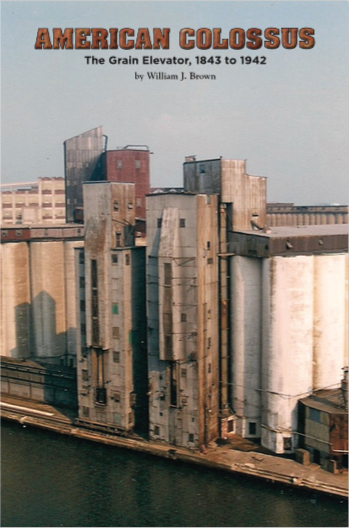
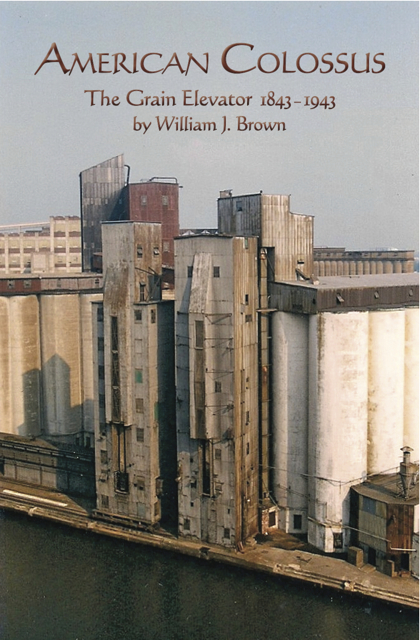
Grain, the world's single most important commodity, does not exist separately from the collection and storage units and the transportation systems that bring billions of bushels of it from the farm to market every year. Invented in Buffalo, New York, in 1843, as a solution to a particular problem (transshipping grain in bulk from lake to canal), the steam-powered grain elevator ended up being of such general utility that it led to the intense and rapid growth of American agriculture and thus to the rise of the country as a whole. Though they are present in both the cities and the prairies, grain elevators are little known among the general public and have received scant coverage in such specialized fields as modern architecture, industrial archaeology, agricultural history, and urban studies. As a result, very few of the people who depend upon these colossal machine-buildings for their daily bread know what "grain elevators" are. Indeed, the very phrase might even sound odd to them. Building upon the pioneering work of Reyner Banham (author of A Concrete Atlantis: U.S. Industrial Building and European Modern Architecture), William J. Brown has written the first history of the American grain elevator from 1843 to 1943.


Contents:

Preface
Acknowledgements
Introduction
Chapter 1: Grain Power
Chapter 2: The Metaphor of Elevation
Chapter 3: The Rise and Fall of the Port of Buffalo
Chapter 4: Fireproofing the Tinderbox
Chapter 5: American Colossus
Chapter 6: The European Modernists
Chapter 7: Reyner Banham
Chapter 8: Town and Country
Chapter 9: On Dwelling
Appendix: The Grain Elevators of Buffalo
Bibliography
Index

American Colossus: The Grain Elevator, 1843 to 1943
William J. Brown (author)
472 pages, eight b/w photographs
ISBN 978-0-578-01261-2
Published by Colossal Books
Paperback only. $29.99


To order a copy of American Colossus:
www.lulu.com, item number 6054599
Amazon Books
contact us directly at colossal.publisher@gmail.com

Read the author's blog


Praise for American Colossus


"American Colossus: The Grain Elevator, 1843 to 1943 is a provocative, thought-provoking and informative must-read for grain elevator aficionados."

Mark Sommer, The Buffalo News, 20 December 2009

"Though it focuses upon Buffalo, the city in which the grain elevator was invented and perfected, Brown's history also examines the beginnings of the grain trade in several other key cities, including Minneapolis, Montreal, New York, Chicago and New Orleans. There are even discussions of grain elevators built in Argentina, France, Germany, Iraq and the Soviet Union. When necessary, Brown has translated documents from the original French, which allows us better access to information about grain elevators built in Montreal, and he has double-checked existing translations from the original German, which helps us re-evaluate the fantastic claims made about American getreidespeicher by European modernist architects in the 1910s and 1920s (many of these architects were German). Brown's scope and methodology perfectly suits a trade in which the local, national and international levels are closely linked."

from the preface by
Marshall Brown
Urban Designer and Architect
Assistant Professor, Illinois Institute of Technology


"Art historians, cultural critics, and others have long disagreed about the advent of the intertwined phenomena known as 'modernity' and 'modernism.' Some have dated their beginnings in Zurich and Berlin in the 20th century; others have claimed an even earlier appearance, pointing to Paris in the 1860s. William Brown's book about grain elevators makes the highly original claim that the essential aspects of modern society were already present in America in the 1840s. Replacing the skyscrapers of Chicago and New York City with the towering grain elevators of Buffalo and Minneapolis, Brown re-tells the history of the modern city in a fresh and interesting way.

"Throughout this remarkable book, I am reminded of Walter Benjamin's 'Arcades Project,' which was a massive and unfinished work about Paris in the first decades of the 19th century. Like Benjamin, from whom he draws for both insights and citations of other writers, Brown calls upon a wide range of sources: the Bible, Sigmund Freud, Martin Heidegger, Karl Marx, Lewis Mumford, Charles Demuth, Frederick Jackson Turner, Charles Baudelaire, William Shakespeare, Anthony Trollope, Ken Kesey, Jacques Derrida, Francisco de Goya, Walter Gropius, and even Star Trek. The result is a brilliant cultural study of grain elevators, and a very rewarding read."

Dr. Kimberly A. Paice
Assistant Professor, Art History, University of Cincinnati


Copyright 2009. Colossal Books. All rights reserved.
PO Box 20201, Cincinnati, Ohio, 45220.
colossal.publisher@gmail.com